כרזה
הביתה בלוג

The Future of Bag Packaging Compliance Under the EU PPWR

בלוג

The Future of Bag Packaging Compliance Under the EU PPWR

July 07, 2026

On 12 August 2026, the EU Packaging and Packaging Waste Regulation (PPWR, EU 2025/40) will officially become applicable. This is far more than a routine regulatory update—it represents a fundamental shift from a Directive to a Regulation, meaning that all packaging placed on the EU market, including bags, dust bags, and transport bags, will be subject to directly applicable and harmonized mandatory compliance requirements across all Member States.

For bag manufacturers and brand owners serving the European market, understanding the PPWR implementation timeline and its technical requirements is no longer optional—it has become an essential prerequisite for market access.

Packaging and Packaging Waste Regulation

Table of Contents

  • What Is the PPWR? 
  • The Five Core Requirements of the PPWR 
  • The PPWR Compliance Timeline Every Brand and Manufacturer Must Understand 
  • How Can We Help Brands Meet PPWR Compliance Requirements? 
  • Frequently Asked Questions (FAQ)


I. What Is the PPWR?

To understand the impact of the PPWR, it is essential to first understand its fundamental transformation.

Previously, packaging in the European Union was governed by Directive 94/62/EC. Under a Directive, the EU establishes the overall framework, while each Member State transposes it into its own national legislation. As a result, packaging regulations have varied in their implementation across countries such as Germany, France, and Italy, requiring businesses to adopt country-specific compliance strategies.

The PPWR, by contrast, is a Regulation. Once it becomes applicable, it will apply directly in all EU Member States without the need for national implementing legislation. This means:

  • Harmonized enforcement standards: There will no longer be opportunities to exploit differences in enforcement between countries, such as stricter rules in Germany and more lenient requirements in Italy. 
  • Higher compliance thresholds: Requirements relating to recyclability, restrictions on hazardous substances, and packaging labeling will become mandatory rather than recommended. 
  • Extended responsibility across the supply chain: Whether you are a brand owner, importer, distributor, or an e-commerce seller, anyone placing packaged products on the EU market must fulfill the corresponding legal obligations. 

This means that regardless of where your finished bags are manufactured, if they are ultimately sold in the EU, their packaging must comply with the mandatory requirements of the PPWR.


Why Is the Bag Industry Included?

The PPWR has an extremely broad scope. It applies to all packaging, regardless of material, intended use, or whether it is used in B2B or B2C applications.

For bag manufacturers, the following three categories of packaging are directly covered by the Regulation:

Packaging Type

Key Compliance Considerations

Finished Product Dust Bags / Non-Woven Bags

Classified as sales packaging and must comply with requirements for recyclability, labeling, and EPR registration.

Shipping Cartons / Courier Bags

Must meet packaging minimization requirements (including limits on empty space) and recyclability requirements.

Inner Liners / Hang Tag Bags

Multi-material constructions may face a reduced recyclability rating, increasing compliance risks.

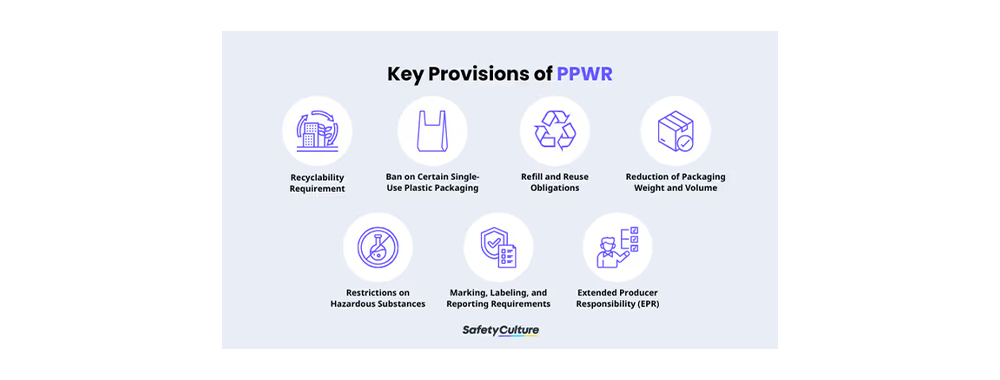
Key Provisions of PPWR


II. The Five Core Requirements of the PPWR

1. Recyclability: Graded Requirements Starting in 2030

The PPWR requires all packaging to be recyclable. By 1 January 2028, the European Commission will establish Design for Recycling (DfR) criteria, introducing a four-tier recyclability rating system (Grades A, B, C, and D).

Starting in 2030, all packaging placed on the EU market must achieve at least Grade C (70% recyclable). By 2035, only Grade A and Grade B packaging will be permitted to remain on the market.

Direct Impacts on Bag Packaging

  • Plastic bags should be made from a single material (such as 100% PE or 100% PP) rather than multi-layer composite materials that are difficult to recycle. 
  • Paper cartons should consist of standard corrugated cardboard without wax coatings, plastic windows, or metallic inks that could contaminate the recycling process. 
  • Bubble wrap and foam fillers should be phased out in favor of recyclable alternatives such as molded pulp or corrugated cardboard inserts.

2. Recycled Content: Mandatory Requirements for Plastic Packaging

The PPWR introduces mandatory minimum post-consumer recycled (PCR) content requirements for plastic packaging, with progressively higher targets over time:

Timeline

PET Contact-Sensitive Packaging

Other Plastic Packaging

2030

30%

10%

2040

50%

30%

3. Restrictions on Hazardous Substances: PFAS and Heavy Metal Limits

Starting on 12 August 2026, the following restrictions will take effect immediately:

  • Total heavy metal content: The combined concentration of lead (Pb), cadmium (Cd), mercury (Hg), and hexavalent chromium (Cr⁶⁺) must not exceed 100 mg/kg in any packaging component. 
  • PFAS restrictions: Per- and polyfluoroalkyl substances (PFAS) in food-contact packaging will be subject to strict limits: 
  • oIndividual PFAS: < 25 ppb 
  • oTotal extractable (degradable) PFAS: < 250 ppb 
  • oTotal PFAS (including polymeric PFAS): < 50 ppm 

For the bag manufacturing industry, waterproof coatings, metal zippers, printing inks, and PVC hang tags are considered high-risk sources of heavy metals and PFAS. These materials should be prioritized during pre-production supplier audits and supply chain compliance assessments.

4. Packaging Minimisation: Eliminating Excessive Packaging

The PPWR requires that the weight and volume of packaging be minimized while still fulfilling its intended function.

By 2030, transport packaging must not exceed an empty space ratio of 50%.

For bag exporters, this means:

  • Avoid using oversized shipping cartons for relatively small bags. 
  • Reduce unnecessary inner fillers and cushioning materials. 
  • Optimize carton dimensions and bag folding methods to improve packing density and maximize shipping efficiency. 

5. Harmonised Labelling: Mandatory from 2028

The EU will introduce a harmonised packaging labelling system, including:

  • Material composition identification 
  • Waste sorting and disposal instructions 
  • QR codes for reusable packaging 

It is expected that from August 2028, all newly placed packaging will be required to carry compliant labels in accordance with the PPWR.

carry compliant labels in accordance with the PPWR


III. The Compliance Timeline Every Brand and Manufacturer Must Understand

The EU Packaging and Packaging Waste Regulation (PPWR) will have a significant impact on brands and manufacturers. To prepare for increasingly stringent packaging requirements and manufacturing standards, it is essential to understand the Regulation's phased implementation timeline.

Date

Milestone

11 February 2025

The PPWR officially entered into force, becoming a legally binding EU Regulation.

12 August 2026

General application date when the majority of the PPWR provisions become mandatory across EU Member States.

31 December 2026

The European Commission will finalize the legislative framework for calculating recycled content, providing businesses with practical rules for the transition period from 2027 to 2030.

1 January 2030

• All packaging placed on the EU market must be recyclable.
• Specific types of single-use plastic packaging will be fully prohibited.
• Mandatory minimum recycled content requirements for plastic packaging will be fully implemented.

2035–2040

• Further packaging waste reduction targets will take effect.
• Reuse targets will be increased.
• Recycled content requirements will become more stringent.


IV.  How Can We Help Brands Meet PPWR Compliance Requirements?

At SYNBERRY BAG, we do not view the PPWR simply as an additional compliance cost. Instead, we see it as an opportunity to strengthen product competitiveness by integrating compliance into every stage of product development and manufacturing. Together with our customers, we are implementing three key strategies.

Strategy 1: Build a PPWR-Compliant Materials Portfolio

We have systematically developed a portfolio of materials that align with the PPWR's evolving requirements, including:

  • GRS-certified rPET fabrics: Made from 100% post-consumer recycled polyester, these materials help meet the minimum recycled content requirements for plastic packaging while offering a mono-material structure that enhances recyclability. 
  • Organic cotton and recycled cotton: Natural, biodegradable fibers that can be paired with FSC-certified paper for hang tags and care labels to improve overall packaging sustainability. 
  • PFAS-free water-repellent canvas: Manufactured using C0 fluorine-free durable water repellent (DWR) technology and tested to comply with PFAS restrictions. 

Strategy 2: Integrate Compliance into the Product Development Stage

We have moved PPWR compliance checks upstream by incorporating them into our sample development and pre-production approval process.

This includes:

  • Verifying during material selection that raw materials are free from restricted substances such as PFAS and heavy metals. 
  • Evaluating product construction for recyclability to avoid attractive but difficult-to-recycle multi-material designs. 
  • Reviewing packaging artwork and labels to ensure that material identification and recycling instructions comply with EU requirements. 

Strategy 3: Make Compliance Verifiable Through Documentation

We provide end-to-end documentation support, from material traceability to final compliance documentation, helping brands demonstrate conformity with confidence.

Our support includes:

  • Material compliance: Recommending PPWR-friendly materials such as GRS-certified recycled materials, PFAS-free water-repellent fabrics, recyclable materials, and FSC-certified paper. 
  • Testing support: Coordinating third-party laboratory testing for heavy metals, PFAS, and chemical compliance with regulations including REACH, CPSIA, and California Proposition 65. 
  • Compliance documentation package: Supplying each order with a Material Composition Declaration, Supplier Compliance Certificates, and Packaging Recyclability Statements to support your EU Declaration of Conformity (DoC). 

These documentation packages not only help meet regulatory requirements but also serve as valuable evidence of supply chain transparency, enabling brands to demonstrate compliance and sustainability credentials to downstream partners such as EU importers and retailers.


FAQ: Common Questions About PPWR for the Bag Industry

Q1: Does the PPWR only apply to food packaging? Do fashion bags also need to comply?

A: No. The PPWR applies to all packaging placed on the EU market, regardless of whether it is used for B2B or B2C, or for food or non-food products. For fashion bags, packaging such as dust bags, shipping cartons, and inner liner bags all fall within the scope of the Regulation.

Q2: Our bags currently use a C6 water-repellent coating. Will this automatically be non-compliant?

A: C6 water-repellent coatings belong to the PFAS family (short-chain per- and polyfluoroalkyl substances). Although the detailed PFAS restrictions under the PPWR are still being refined, the EU's overall regulatory direction is toward progressively restricting PFAS.

It is advisable to begin transitioning to C0 fluorine-free water-repellent technologies—such as paraffin-based, silicone-based, or bio-inspired nano water-repellent finishes—from 2025 onward. Brands should also request PFAS non-detect test reports from fabric suppliers, with detection limits typically below 25 ppb.

Q3: Does the Declaration of Conformity (DoC) need to be issued by a third-party organization?

A: No. The PPWR adopts a self-declaration approach. The manufacturer or importer is responsible for signing the Declaration of Conformity (DoC) based on the supporting technical documentation.

However, the technical file should generally include test reports—such as heavy metal analyses—issued by qualified and accredited laboratories.

Q4: As a non-EU brand, do we need to register for EPR in the EU?

A: Yes. If you place packaged products on the EU market through an importer, distributor, or an e-commerce platform (such as Amazon), you are considered a "producer" under the PPWR.

You must register with the Extended Producer Responsibility (EPR) system in each EU country where your products are sold. If your company does not have a legal entity established within the EU, you will generally need to appoint an Authorized Representative to fulfill your compliance obligations.

Q5: How is the 50% empty space limit calculated under the PPWR?

A: The empty space ratio is calculated as:

Empty Space Ratio = (Internal Packaging Volume − Actual Product Volume) ÷ Internal Packaging Volume × 100%

Under the PPWR, the empty space ratio for grouped packaging, transport packaging, and e-commerce packaging must not exceed 50%.

For flexible products such as bags, this requirement can typically be met by:

  • Compressing the packaging where appropriate 
  • Optimizing folding methods 
  • Selecting shipping cartons that better match the product dimensions 

Transport packaging used solely for pallet protection (such as pallet stretch wrap) is not subject to this requirement.

Q6: If our packaging was manufactured before 12 August 2026, is it exempt from the PPWR?

A: No. The PPWR applies to packaging placed on the EU market from 12 August 2026 onwards, regardless of when the packaging itself was manufactured.

If existing packaging inventory enters the EU market for the first time after 12 August 2026, it must still comply with the Regulation. Rather than relying on pre-produced inventory, businesses are strongly encouraged to complete the compliance transition for their entire packaging portfolio well in advance.


Conclusion

The full implementation of the PPWR marks a fundamental shift in the EU market—from competing primarily on price to competing on compliance.

For B2B bag buyers and brands, this presents not only a regulatory challenge but also an opportunity to strengthen customer trust and enhance long-term competitiveness.

Brands that complete their PPWR compliance preparations before August 2026 will demonstrate greater supply chain maturity, stronger environmental responsibility, and a deeper commitment to long-term partnerships in the eyes of EU buyers.

At SYNBERRY BAG, this is exactly the goal we strive to achieve together with every customer—helping brands turn regulatory compliance into a lasting competitive advantage.

  Author  


צור קשר
כתובת : Unit 905, Block B, Jinri Building, No. 88 Anling Second Road, Huli District, Xiamen, Fujian, China
לְהִתְקַשֵׁר

אנא המשך לקרוא, להישאר מעודכן, להירשם, ואנו מזמינים אותך לספר לנו מה אתה חושב.

Linkedin WhatsApp Facebook instagram

זכויות יוצרים @2024 Synberry Bag & Package Products Co.,Ltd כל הזכויות שמורות . רשת נתמכת

מפת אתר / בלוג / Xml / מדיניות פרטיות

השארת הודעה

השארת הודעה
אנו נרגשים לדון כיצד המומחיות שלנו יכולה לספק מוצרים איכותיים ומושכים, התחל את השיחה כאן, בואו להתחבר וליצור!
שלח

הביתה

מוצרים

וואטסאפ

צור קשר