
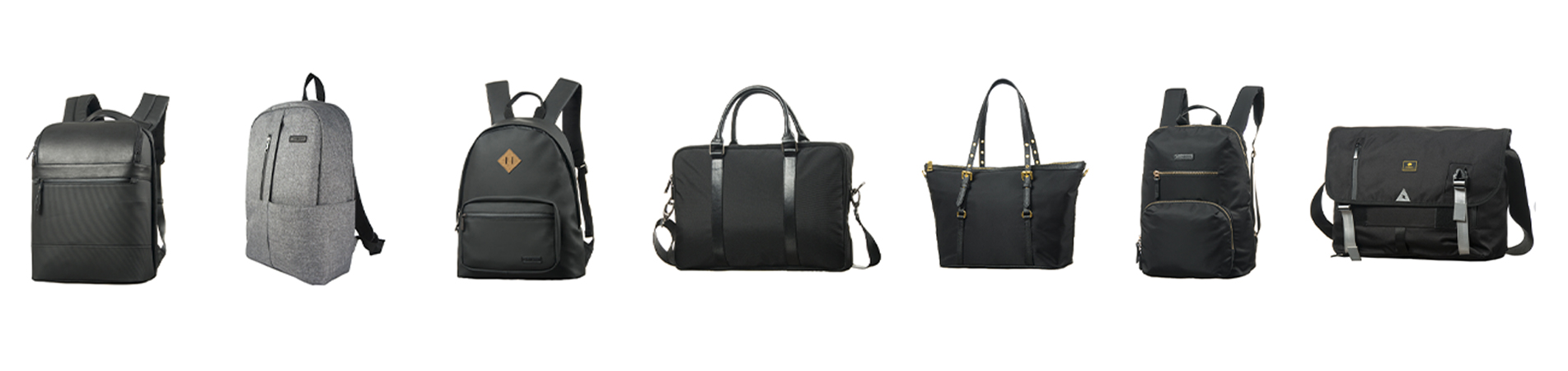
Customizing an AirTag backpack usually follows one of two cooperation models — the "bare bag" model and the "bundle" model.
Whichever model you choose, the core engineering work is the same: adding a purpose-designed AirTag holder structure to the standard backpack development process. First, define the product positioning and usage scenarios. Next, work with the backpack OEM/ODM factory to complete the holder's structural design, material selection, and prototype testing. Finally, layer in brand elements such as your logo, color schemes, and packaging, then move into mass production and delivery following the standard inspection process.
The difference between the two models lies not in the product itself, but in the commercial arrangements: who procures the AirTags, who bears the shipping compliance responsibility for products containing lithium batteries, and who controls the regulatory certifications for the target markets. What looks like simply "adding a small pocket" is, in fact, systematic engineering that spans five dimensions: structural design, signal compatibility, anti-loss safety, supply chain quality control, and certification compliance.
Table of Contents:
I. What Is an AirTag Tracker?
II. Product Positioning: Does Your Brand Need This Category?
III. Scenario Positioning: How Should It Be Done?
IV. Practical Solutions in the AirTag Backpack OEM Process
V. How We Implement Quality Control in Specific Orders
VI. Certifications and Compliance for AirTag Backpacks
VII. Frequently Asked Questions (FAQ)
VIII. Conclusion
Before customizing, you first need to understand what an AirTag is and confirm whether this category makes sense for your brand — this determines the scale of every investment that follows.
The AirTag is a Bluetooth tracking device launched by Apple. Shaped like a small round disc, the official model measures about 31.5 mm in diameter and about 8 mm thick, weighing only 11 grams. It contains a built-in speaker, an accelerometer, and a Bluetooth chip, and it locates items through Apple's "Find My" network. Users place an AirTag inside a backpack or suitcase, or attach it to their keys, and can then view the item's location on their phone. When an item is lost, they can enable Lost Mode, which lets nearby passing Apple devices help relay location information back to them.
For backpack brands, the key to understanding how AirTag works lies in its relationship with the bag itself: the AirTag does not rely on GPS for positioning. Instead, it reports its location through Bluetooth interaction with surrounding Apple devices, which means its signal quality depends heavily on the materials and shielding conditions around its mounting position.
In addition, the AirTag is powered by a coin cell battery with a battery life of about one year, and users need to replace the battery periodically. This means the holder must balance two requirements: "easy to insert and remove" and "not easy to fall out." Its diameter and thickness also define the basic dimensional constraints of the holder design — if the holder is too shallow, the AirTag can easily slip out; if it is too tight, users will struggle considerably when replacing the battery.
AirTag backpacks solve a real and high-frequency pain point: bags getting lost, taken by mistake, or stolen. Apple's "Find My" network relies on hundreds of millions of Apple devices worldwide relaying location data, giving a tiny tracker near-global coverage for recovering lost items. For consumers, building an AirTag into a backpack or attaching one to it is like taking out a "recoverable" insurance policy on their belongings. For brands, it delivers fourfold value:
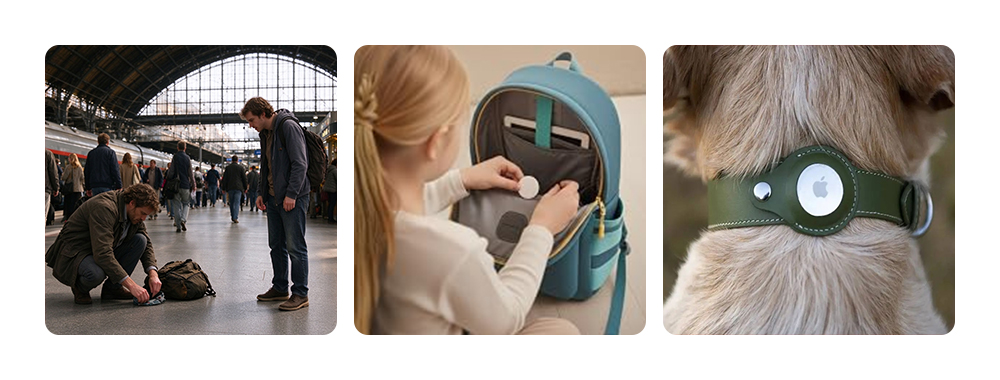
Once you have a reason to do it, the second step is to understand the usage requirements of each scenario, because scenario positioning directly determines where the holder should be placed and how it should be built.
Different scenarios have entirely different requirements for the AirTag holder:
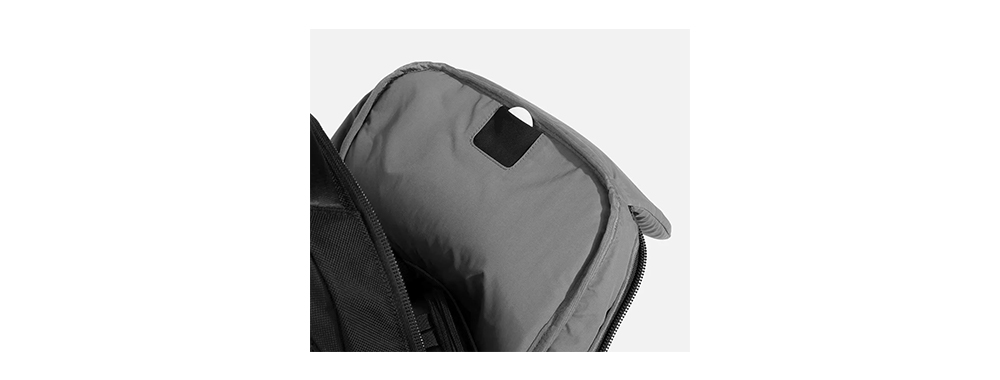
4.1.1 Hidden Built-In Structure
A hidden built-in structure tucks the AirTag holder entirely inside the backpack, with no visible opening or marking on the exterior. It suits commuting and business travel scenarios that pursue a clean appearance, where the anti-loss need is mainly "recovering your own item."


4.1.2 Convenient External-Mount Structure
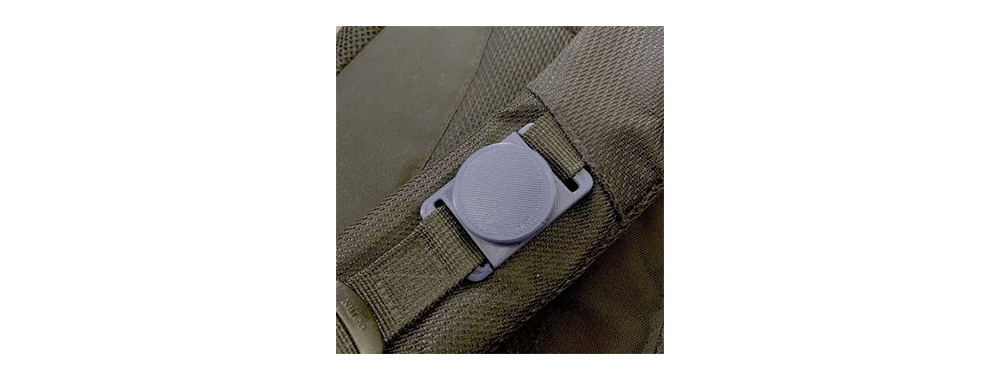
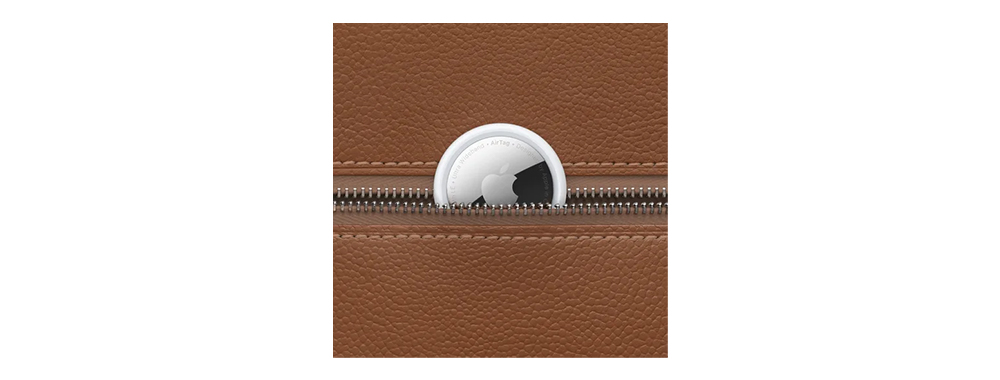
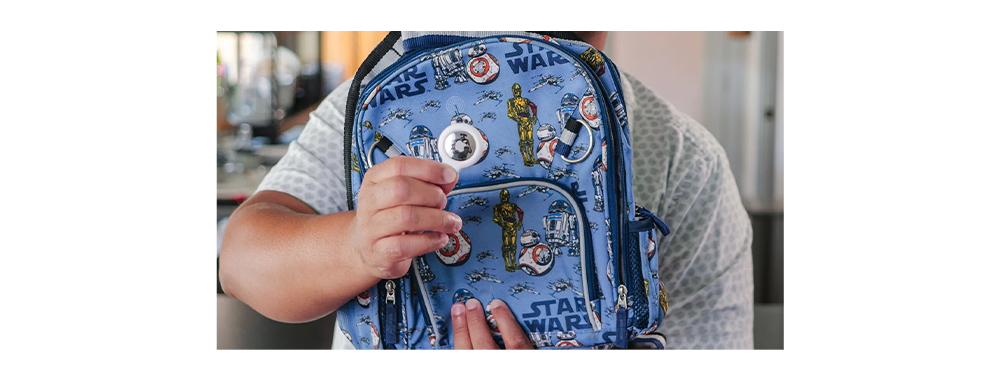
Designed for quick personal item-finding, the core requirement of an external-mount structure is "always within reach" — users can see or feel where the AirTag is without opening the main compartment and digging around. It suits high-frequency outings such as daily commuting, walking the kids, or walking the dog. Common approaches include the following:

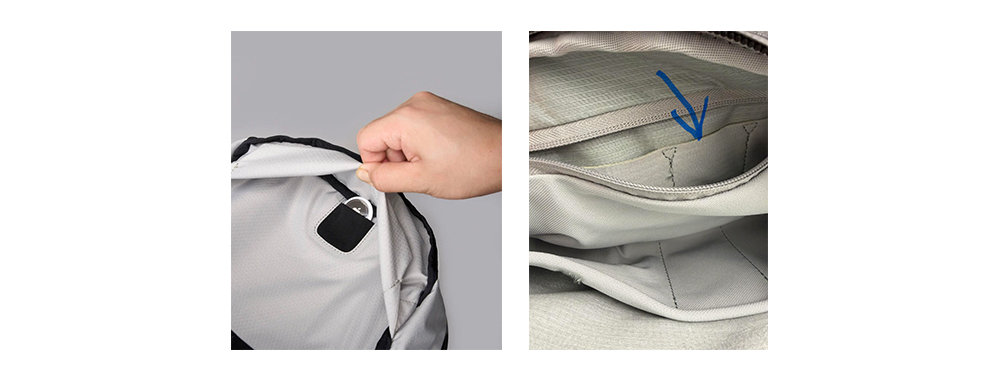
For premium business travel backpacks, we recommend prioritizing the hidden built-in solution: the hidden pocket is fixed to the inside of the back panel or within an internal zippered pocket, with no visible opening on the exterior. This balances concealment with a premium feel while retaining an open-and-close access channel, so users can replace the battery without rummaging through the main compartment. If your brand wants to emphasize the "quick confirmation" experience during travel, a woven-label marker can be added to the lining compartment, allowing users to identify the AirTag's location by touch without opening the bag.
One point worth noting: once the holder solution is finalized, all subsequent structural prototyping, mold development, and production-line fixtures will be built around it. We therefore recommend confirming the backpack pattern, lining structure, and holder together at the solution review stage, to avoid rework later caused by changes in lining thickness or stitching direction.
Material selection must satisfy two goals at once: the functionality of the AirTag holder, and the quality consistency of the entire bag.
The standard bag production process begins with confirming the design and craftsmanship, followed by prototype confirmation; mass production only begins after the sample is approved, and the goal at this stage is "consistency with the approved sample." As a professional backpack factory, our quality control process includes:
Quality control solves the consistency of the product itself; certifications and compliance solve the legality of the product entering the market. AirTag backpacks straddle two domains — "luggage + electronic accessory ecosystem" — which adds an extra layer of compliance considerations compared to ordinary backpacks. We break them down into four aspects:
6.2.1 On the Backpack Side:
6.2.2 On the AirTag Side:
The hidden inner pocket solution involves no mold-making, so its MOQ is usually the same as that of an ordinary custom backpack (commonly starting from 500 units). The holder tray solution requires an injection mold, so factories generally demand a higher MOQ (1,000 units or more) to spread out the mold cost. The specifics depend on the factory and the complexity of the craftsmanship. When requesting quotes, we recommend writing the holder solution into the specification sheet before comparing prices.
Both models are viable. Most brands choose "no AirTag included," noting on the packaging and product page that "AirTag sold separately" — this keeps both costs and legal risks at their lowest. The bundle model brings a higher average order value, but you must solve the legitimate AirTag procurement channel and the shipping compliance issues for products containing lithium batteries on your own.
It depends on the cooperation model. MFi certification targets electronic accessories that use Apple's connectors and protocols (such as Lightning cables); a purely structural storage holder does not fall within its scope. However, if the AirTag is sold together with the bag, MFi certification is required.
Not as long as it is properly designed. The AirTag works via Bluetooth and UWB, and nylon, polyester, genuine leather, silicone, and PC/ABS plastics cause no shielding. What you truly need to avoid is fully enclosing the AirTag in metal materials.
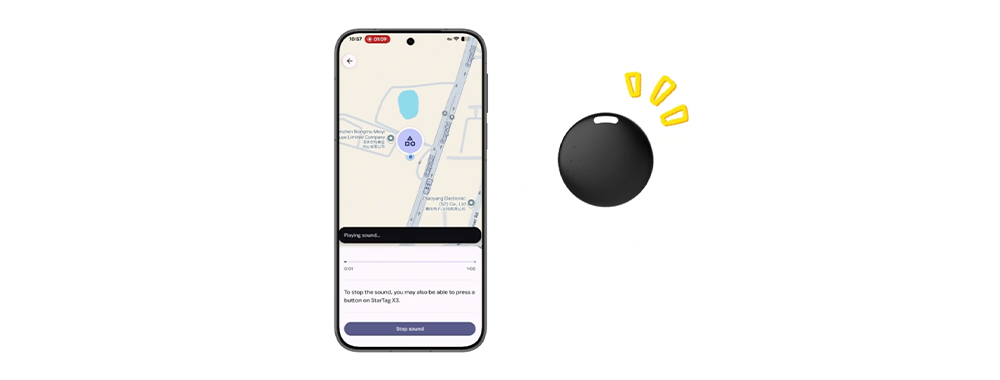
Yes, but the dimensions must be re-verified. The official Apple AirTag (31.9 mm in diameter), Samsung Galaxy SmartTag (about 39 mm square), and Tile Mate differ considerably in size, so a single holder can hardly fit them all. If Android users make up a high share of your target market, you can develop a dual solution of "AirTag holder + universal attachment point," or supply different versions for different markets.
There are two: the holder must have a protective cover or locking structure that prevents accidental swallowing (one that children cannot open with their bare hands); and exports to the U.S. must comply with CPSIA and be accompanied by a CPC certificate.
For a brand looking to enter the smart backpack category, turning an idea into a product line that can be delivered stably is, at its core, a test of supply chain capability. What it tests is not just whether a bag manufacturer is willing to add one more holder, but whether someone can walk the brand through every step — from structural design, material selection, and signal validation to certification and compliance. What SYNBERRY BAG has accumulated across these steps is precisely this kind of hands-on experience that puts details into practice: every design is backed by test evidence, every inspection has traceable records, and every certification document can be delivered along with the order.
If you are evaluating the feasibility of an AirTag backpack product line, feel free to share with us the certification requirements of your target market, your intended bag patterns, and your approximate order volume. We can first provide recommendations on the holder solution, and then quote a practical, deliverable development and production plan based on it.
| Author | ||||||
|
אנא המשך לקרוא, להישאר מעודכן, להירשם, ואנו מזמינים אותך לספר לנו מה אתה חושב.




זכויות יוצרים
@2024 Synberry Bag & Package Products Co.,Ltd כל הזכויות שמורות
.
 רשת נתמכת
מפת אתר / בלוג / Xml / מדיניות פרטיות